



Recently, footage capturing close-ups of an enormous, bizarre creature alongside chains of glass-like transparent egg sacs has left the public utterly astonished. Is this a monstrous beast lurking in the depths, or a rare prehistoric relic surviving in modern times?
Wild nature has always concealed mysterious, shadowy depths that leave even the most seasoned observers spellbound upon witnessing them firsthand. Newly documented footage recorded at a riverside breeding and research station has unveiled the astonishing life cycle of one of Earth’s oldest surviving species: the giant salamander (often called the “living fossil” of the riverbeds).
1. A Breathless Struggle by the Pond: Grappling with a Massive, Slippery Beast
Right from the opening seconds, viewers are gripped by suspense as a middle-aged man strains with all his might to hold a colossal, smooth-skinned “monster”. The creature boasts a massive, grayish-black frame comparable in size to a young child, its stout limbs thrashing violently in his arms.
Its slick, slime-coated body forces the handler to tense every muscle, carefully treading along the embankment before releasing it onto the lush grasses by the water. Far from showing fear, his deliberate movements demonstrate the seasoned expertise needed to manage this massive amphibian. It is a scene both fascinating and eerie, prompting viewers to wonder: “Where did this peculiar creature come from, and how dangerous is it?”.
2. A Lightning-Fast Ambush and an Ominous, Crimson Gape
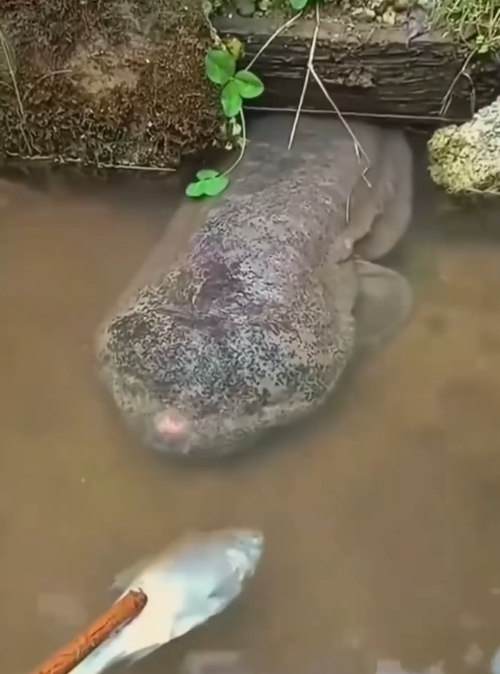
The display of raw mass is only the beginning. The lens soon pans into murky shallows where another specimen lies motionless, concealed beneath a rocky shelf. In a fraction of a second, as a stick tipped with fresh fish drifts near, the broad, flattened head lunges upward with ruthless precision, engulfing the prey whole.
The predatory threat of the creature becomes even clearer in the following scene: lifted from a holding crate by an attendant wearing heavy rubber gloves, the beast spreads its jaws wide, exposing a cavernous, deep-red gullet powered by bone-crushing jaw strength. Although its tiny, degenerate eyes are nearly useless, its sensory skin and keen olfactory senses make it an undisputed sovereign of the shadowed depths.
3. Mysteries of the “Living Fossil” That Outlasted the Dinosaurs
Following these fierce displays, the camera reveals a salamander slithering gently across clear, moss-lined brook stones. Biologists often regard these creatures as “living fossils” because their ancestors emerged during the Jurassic period—well over 160 million years ago.
Weathering colossal geological upheavals that wiped out the dinosaurs, these amphibians endured quietly inside subterranean caverns, breathing through their skin and preserving their lineage across countless millennia. The sight of such robust, thriving specimens serves as a testament to nature’s profound resilience.
4. Strands of “Crystal Necklaces”: The Secret Nursery Deep in the Pit
The documentary takes its most mesmerizing turn when revealing the intricate breeding and incubation process. A bucket overflowing with plump, luminous orbs resembling polished glass beads is gently poured into a specialized underground incubation vault.
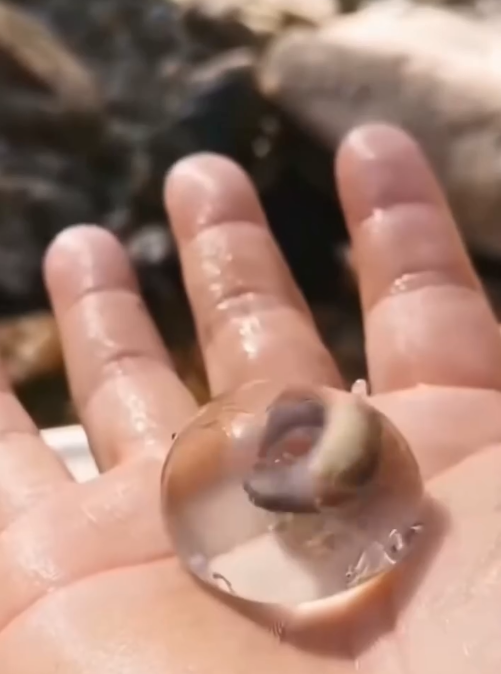
Drawn upward by hand, these formations leave spectators in awe: these are not ordinary loose eggs, but interconnected yolk sacs arranged like exquisite crystal garlands. Encased within each clear, fluid-filled sphere, a pale embryo shifts and stirs, preparing for an extraordinary rebirth. The imagery is so otherworldly and delicate that it leaves onlookers holding their breath at every beat of emerging life.
5. Miracle Droplets Cradling Fragile Life in the Palm of a Hand
Drawing toward the finale, the camera provides breathtaking ultra-close-up shots. These oversized “drops of life” containing developing larvae are displayed cradled inside a palm and resting upon a vibrant green leaf.
As daylight filters through the crystalline membrane, every minute detail of the tiny larva becomes visible: from its delicate tail and external gills blooming like petals to its tiny flutters within its natural amnion. In some instances, a single clear sphere cradles an entire cluster of squirming hatchlings. The stark contrast between the heavy, armored adult and these fragile, dew-like embryos leaves an indelible visual impression.
6. A Silent Battle to Preserve an Ancient Genetic Legacy
Beneath the mesmerizing visual spectacle of artificial incubation lies a sobering reality: in the wild, giant salamanders face critical endangerment driven by river pollution and illicit poaching for the luxury dining trade.
The dedicated conservationists and technicians shown in the footage work tirelessly day after day, monitoring water temperatures and subterranean currents to safeguard this prehistoric lineage for future generations. Each crystal egg that successfully hatches represents far more than an ecological milestone—it is a vital lifeline pulling an ancient creature back from the brink of extinction.
KEY TAKEAWAYS FROM THE VIDEO
- Respect and Understand Nature’s Design: A creature that appears formidable or peculiar on the surface often harbors an extraordinarily delicate reproductive cycle. We should never judge nature solely by its rugged exterior.
- The Urgency of Clean Freshwater Conservation: Giant salamanders can only reproduce and develop in exceptionally pristine, cool freshwater streams. Their decline in the wild serves as a stark warning about human-induced water pollution.
- The Value of Patience and Meticulous Care: Preserving rare, ancient life requires painstaking dedication from the very earliest stages of development. True achievements in any endeavor stem from patience and a steadfast commitment to protecting fragile beginnings.