


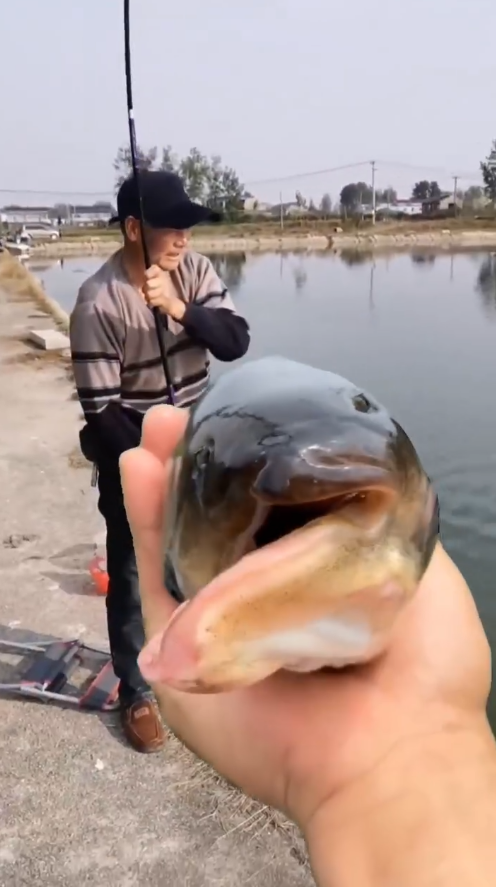
Nature always holds fascination, yet at times, abnormal appearances among wildlife provoke a shudder rather than mere curiosity. Across freshwater lakes where anglers seek tranquility by their rods, bizarre spectacles emerging from the water are sparking widespread public intrigue. A series of real-life footage capturing fish with unfathomably deformed heads has recently surfaced, raising a flurry of mysterious questions: Is this a rare, undiscovered species, or the heartbreaking outcome of an abnormal mutation beneath the lake bed?
1. A Breathless Moment as an Angler Encounters a “Monster Fish”
Amidst the tranquil scenery of open waters, an angler reeled in a sizeable catch of considerable weight. Yet, the moment the prize was lifted from the water, the fisherman was startled by its bizarre appearance. Instead of the familiar rounded skull and neatly closed mouth of freshwater fish, the creature’s head curved upward in an unsettling manner.
The lower jaw jutted far forward, arching like a bird’s beak or a plowshare, while the upper jaw receded deeply inward. Its gaping mouth remained permanently agape, as if frozen in a silent cry for air. Anyone looking directly into this abnormal face would feel a chill down their spine, as though confronting a creature spawned from mythological folklore of the deep river abyss.
2. The Bizarre Hooked Beak and an Abnormal Anatomy
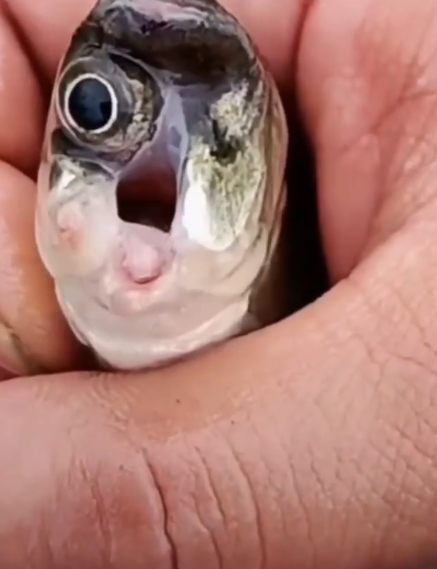
Held firmly in hand and turned across different angles for the camera, the deformity became unmistakable. The fish’s bulging eyes were positioned unnaturally far back compared to standard cranial anatomy. Its entire upper jawbone appeared either degenerated or severely fractured from an early stage, lending the snout the sharp profile of a raptor’s beak.
Despite the grotesquely warped head, the remainder of the body—from fins and scales to the tail—was well-developed and smooth. In fact, the fish remained remarkably vigorous, thrashing its tail forcefully near the water’s edge. This sparked astonishment among observers: How could a fish with a permanently open mouth, completely unable to close its jaws, capture prey and survive to such an impressive size?
3. More Than an Isolated Incident: A Mysterious Widespread Phenomenon
Had this been an isolated catch, one might shrug it off as an accidental freak of nature. However, the issue grew far more concerning as similar cases were documented across different sizes and water bodies.
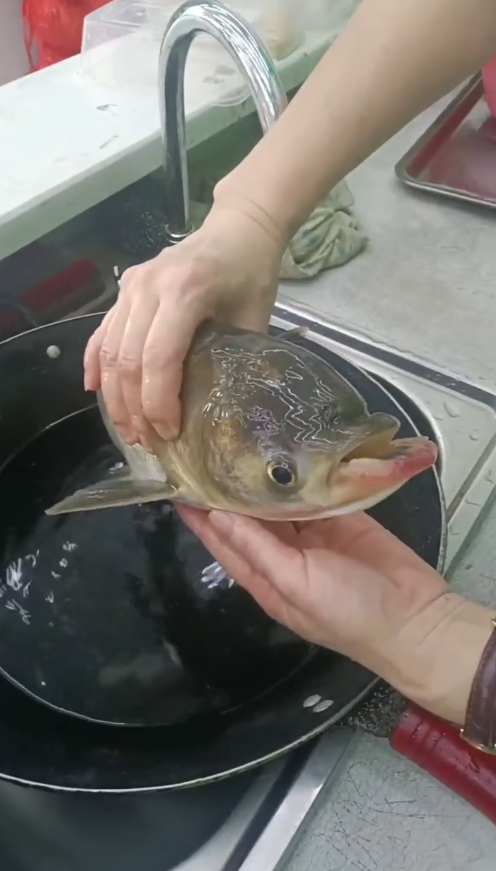
Shortly thereafter, footage emerged of a small, hand-sized fish exhibiting the exact same “bird-beak” deformity. Despite its young age, its head was truncated, the lower jaw curved steeply upward, and its mouth remained permanently wide open like a fixed funnel. Even more remarkably, another larger fish, placed in a kitchen basin for preparation, displayed an identical malformation: a hooked snout, a wide-open reddish oral cavity, and vacant eyes. The recurring discovery of multiple fish sharing the exact same anomaly rules out mere coincidence.
4. Human Interference or Nature’s Backlash from Contaminated Waters?
Faced with this stark footage, seasoned observers and elders well-versed in waterways have raised sobering theories. Could these fish have been exposed to toxic chemicals or heavy metals settling in the benthic silt during their embryonic stage?
Many environmental experts note that cranial deformities in fish—often categorized as pughead or beak anomalies—frequently stem from severe water contamination, pesticide runoff from adjacent farmland, or genetic mutations triggered by ecological disruption. When freshwater habitats lose their pristine balance, subsequent generations of aquatic life bear the brunt through painful deformities, turning them into living anomalies in the wild.
5. Scars from Fishing Hooks and Unintended Carnage
Alongside environmental factors, another compelling explanation offers food for thought: surviving severe trauma from sharp fishing hooks. Many recreational anglers employ treble hooks or jerk their rods with immense force. When a juvenile fish strikes and manages to tear itself free, the pliable jawbone can be severely lacerated or fractured.
Over time, as the wound heals, the broken bone ossifies misaligned, inadvertently developing into a distorted “hooked beak” as the fish matures. While the fish’s survival showcases the tenacious resilience of wildlife, the deformed snout remains a painful testament to the unintended consequences of human recreation.
6. A Haunting Kitchen Scene and Consumer Vigilance
The footage concludes with the sight of a deformed fish thrashing inside a kitchen washbasin prior to being cooked. Its gaping jaws and vacant eyes leave a haunting impression on any home cook. For older generations who prioritize household food safety, this raises an immediate, critical concern: Is the flesh of such deformed fish safe to consume?
Public health authorities consistently advise against consuming seafood or freshwater fish that exhibit abnormal shapes, spinal curvature, or unexplained cranial and facial malformations. Such physical anomalies may indicate a prolonged bioaccumulation of toxins or heavy metals contracted while growing in polluted waterways.
LESSONS FROM THE FOOTAGE
The sight of these gaping, “bird-beaked” fish is not merely a curious visual oddity, but a stern, valuable wake-up call for us all:
- Protect and cherish freshwater ecosystems: Aquatic life serves as a natural thermometer measuring environmental health. Physical deformities in fish deliver an urgent message from nature: the waterways we rely upon may be suffering silent, cumulative poisoning.
- Practice humane, ethical angling: Fishing is a noble pastime, yet it must be conducted responsibly. Anglers should avoid destructive tackle or violent hooksets that mutilate juvenile fish intended for catch-and-release.
- Exercise caution with food selection: Never let novelty, curiosity, or frugality tempt you into consuming seafood or produce showing abnormal mutations or deformities. Safeguarding the health of yourself and your family begins with informed discernment and vigilance in daily meals.